
Pass DWTC 'Better Stands' Audit Before Jan Mega‑Cycle
DWTC Better Stands Material Passport is now a de facto gatekeeper for every space‑only build in the UAE mega‑cycle. With Gulfood, ADSW/WFES and WHX compressing thousands of exhibitors into January–February 2026, organisers and venues are enforcing Bill‑of‑Materials (BOM) / Material Passport requirements strictly — miss the window and you risk fines, withheld sign‑off or expensive remediation.
What the 'Better Stands' / Material Passport Requirement Actually Means — DWTC Better Stands Material Passport
Organisers (DWTC, ADNEC, DCD‑linked events) now require a documented Material Passport for all space‑only stands. The passport sits inside tiered compliance schemes (Bronze / Silver / Gold):
- Bronze: Basic Material Declaration — core materials, fire certificates, and end‑of‑life intent.
- Silver: Full BOM with percentages of reusable content, low‑VOC finishes, LED spec, documented reuse strategy.
- Gold: Certified modular/reusable design, third‑party verification, full lifecycle plan and tracked re‑use commitments.
Required BOM fields typically include:
- Material type (e.g., plywood MR/BB, MDF, aluminium, steel, fabric)
- Percentage reusable by weight and by component (e.g., modular panels 75% reusable)
- Finish (low‑VOC paint/adhesive spec, LED lighting types)
- Fire rating and DCD/ADNEC‑acceptable certificates
- End‑of‑life plan (reuse, donate, recycle stream and destination)
Venues demand this because of waste reduction targets, fire‑safety assurance, sustainability KPIs and the practical need to avoid remediation that delays opening.
Deadlines, Documents & Venue Traps to Watch — DWTC Better Stands Material Passport
Key submission windows and documents you must have ready:
- Submission window: Typically 4–6 weeks pre‑build. For Jan–Feb 2026 events, this means submissions in early December through early January depending on the show.
- Required documents: BOM / Material Passport, RAMS (in English), engineered shop/structural drawings, fire‑test certificates (English), material declarations, and mock‑up photos or sign‑off.
- Empty‑case storage: Many venues enforce a “no in‑booth crate” policy; crates must be offloaded to designated storage yards or removed same day.
- Late‑order surcharges: Power, rigging and internet follow tiered pricing; late orders commonly attract 20–50% surcharges. Venues may also levy remediation fees or withhold certificates of occupancy for non‑compliance.
The Top 6 Exhibitor Failure Modes (and Real Costs) — DWTC Better Stands Material Passport
Here are the most common failures, short examples and estimated cost ranges:
-
Invalid or missing fire/material certificates
Case: MDF panels used without DCD‑acceptable fire test. Cost: immediate rework + replacement panels AED 3,000–20,000; possible remediation fee AED 1,000–10,000.
-
Single‑use, non‑reusable builds
Case: fully painted bespoke joinery that cannot be disassembled. Cost: higher waste disposal fees AED 2,000–8,000 and reputational impact; organiser penalties if Gold/Silver promises not met.
-
Crate & empty‑case penalties
Case: crates left in‑hall. Cost: daily removal/storage fees AED 500–3,000 per day + fines.
-
Customs/ATA mismatches for reusable assets
Case: reusable panels declared as consumables triggering duties. Cost: customs fines + storage, AED 2,000–15,000, and possible stand late opening.
-
Late technical orders → surcharges
Case: late power rigging order. Cost: 20–50% surcharge on vendor fees; typically AED 200–5,000 extra depending on scale.
-
Marshalling‑yard sequencing problems
Case: mis‑timed deliveries causing cranes to wait. Cost: crane/hour and labour penalties AED 1,500–10,000; time lost risks missing inspections.
How Burdak Solves the Problem — DWTC Better Stands Material Passport
We design for compliance from day one. Our step‑by‑step delivery eliminates the common failure modes:
- In‑house material sourcing & BOM creation: We compile the BOM/Material Passport using factory‑verified material specs and percentages.
- CNC precision joinery: Modular panels and knock‑down connections to maximise reusability and reduce on‑site time.
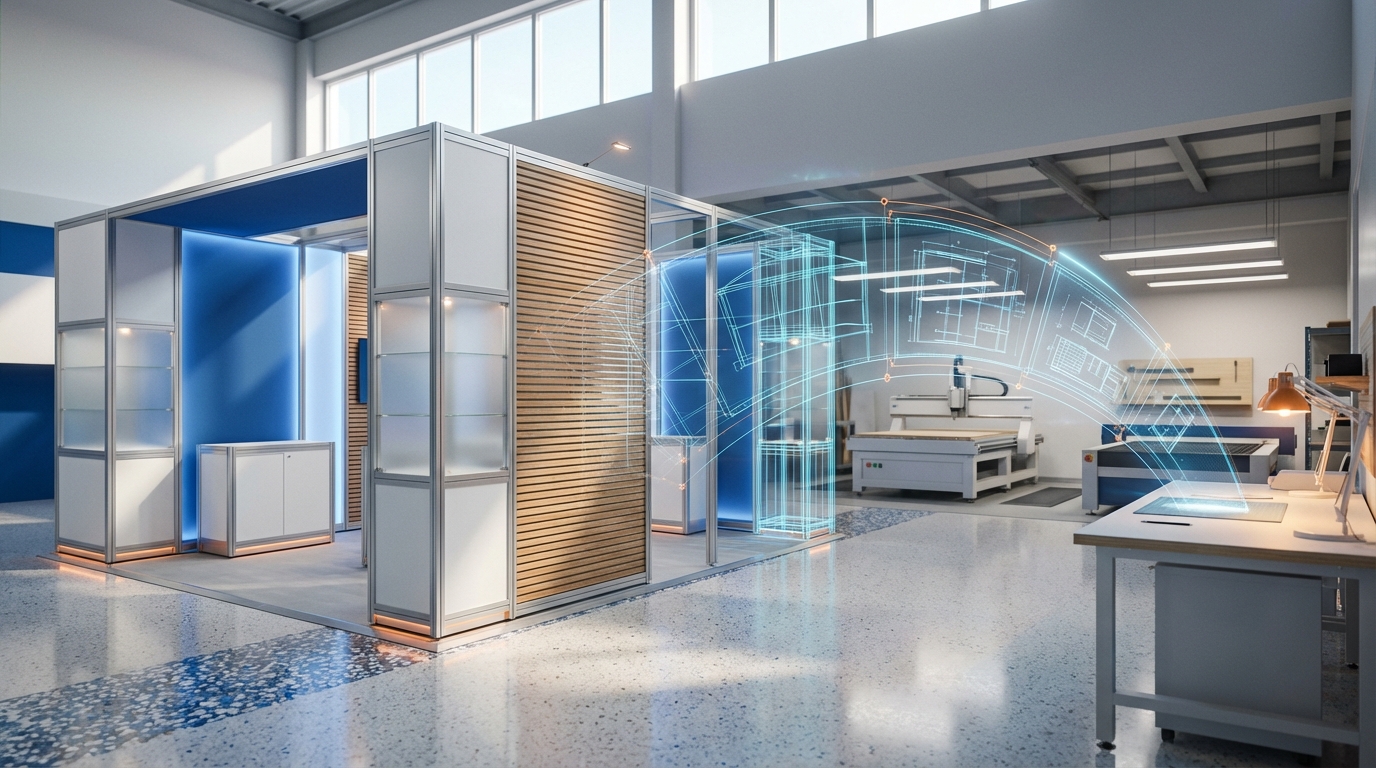
- Full‑scale factory mock‑ups: 3D mockups and full stand mock‑ups for DCD/venue inspection before shipping.
- Pre‑fitted fire‑rating & low‑VOC finishes: Finishes applied in controlled conditions with DCD/ADNEC‑acceptable certificates included.
- DWTC/ADNEC‑ready RAMS and shop drawings: Engineer sign‑off and documentation in English, ready for submission in the 4–6 week window.
- Staged & labelled deliveries: Crates and skids labelled to match marshalling slots and installation sequence to avoid yard delays.
Cost‑saving math (typical): factory pre‑assembly reduces on‑site build labour by 40–60%. Example: a stand with AED 50,000 projected on‑site labour can save AED 20,000–30,000. Avoiding late surcharges (20–50%) on services that total AED 5,000–20,000 saves another AED 1,000–10,000. Combined, the realisable avoidance + labour savings typically offset a 10–25% premium for certified modular builds.
7‑Point Compliance Checklist & 8‑Week Timeline for Writers/Exhibitors — DWTC Better Stands Material Passport
Use this checklist to keep approvals on track.
- 1. BOM/Material Passport with material types, % reuse & end‑of‑life plan.
- 2. DCD/ADNEC‑acceptable fire certificates (English).
- 3. RAMS in English and engineer‑stamped shop drawings.
- 4. Low‑VOC paint/adhesive specs and LED lighting details.
- 5. Full‑scale mock‑up photos or factory sign‑off.
- 6. Marshalling booking and crate labelling plan.
- 7. Export/ATA documentation correctly declaring reusable assets.
8‑Week timeline (week‑by‑week):
- 8 weeks out: Start BOM & select certified materials. (BOM fields prompt: material, density, finish, % reusable, fire rating, supplier cert.)
- 6–5 weeks out: Complete RAMS; engineer sign‑off structural/shop drawings.
- 4 weeks out: Submit Material Passport/BOM to organiser; provide fire certificates.
- 3 weeks out: Factory mock‑up and photos; finalise crate labelling & logistics slot booking.
- 2–1 weeks out: Mock‑up approval, pack labelling, marshalling booking confirmed; freight dispatched to marshalling yard.
Template prompts: BOM fields list, fire‑test certificate format (test body, standard, date, material), mock‑up sign‑off form (photos, dimensions, material callouts, inspector signature).
FAQ — DWTC Better Stands Material Passport
- Q: When is the Material Passport submission due?
A: Typically 4–6 weeks before build; for Jan 2026 shows submit in Dec/early Jan depending on the event. - Q: What if my fire certificate is not in English?
A: Venues require English certificates; provide certified translations or re‑issue in English to avoid delays. - Q: Can we store crates inside the booth overnight?
A: Most venues prohibit in‑booth crates — book empty‑case storage or plan staged deliveries. - Q: How much does late ordering cost?
A: Late orders for power/rigging/internet commonly add 20–50% on vendor fees; planning ahead eliminates this cost. - Q: How does Burdak help with customs/ATA issues?
A: We prepare ATA‑friendly packing lists and classification for reusable assets to avoid duties and delays.
We recommend early engagement. Contact Burdak Technical Services for a DWTC/ADNEC compliance review, BOM validation and a factory mock‑up timeline that aligns with the Jan–Feb 2026 mega‑cycle. With proper documentation and factory pre‑assembly, you remove the biggest sources of cost and risk — and get your stand open on time.