
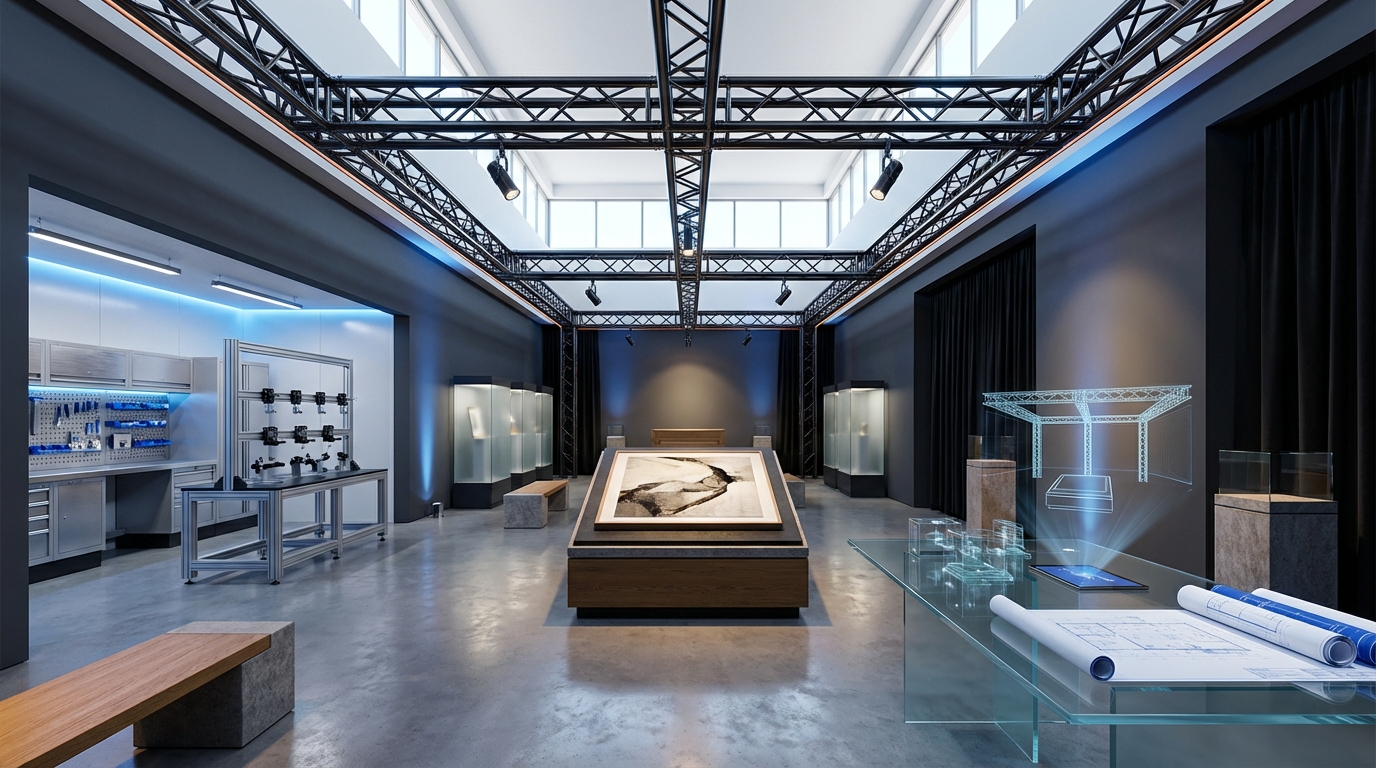
Gallery‑Grade Lighting & Rigging at World Art Dubai
exhibition lighting rigging Dubai is the single biggest technical factor that determines whether artworks photograph sellably, press coverage is maximised and buyers feel confident at World Art Dubai. With Zabeel Halls 3–6 hosting 400+ exhibitors and around 11,000 visitors, the first visual impression — lighting, shadows and secure suspension — is commercial: poorly lit or unstable displays quickly become unsellable or unphotographable.
Why exhibition lighting rigging Dubai decides success at World Art Dubai — commercial impact and common failure modes
Gallery-grade lighting and correct rigging affect three commercial outcomes: image assets (photography/PR), influencer and press perception, and buyer confidence on the stand. Common failure modes we see:
- Poor colour rendering — low CRI LEDs wash out pigment and texture; photos look flat.
- Incorrect CCT — overly warm or cool temperatures skew artwork tones in images and in-person.
- Flicker and refresh incompatibility — video and influencer livestreams reveal strobing not visible to the eye.
- Insufficient or incorrect rigging — unsafe loads, unapproved hanging methods or wrong suspension points lead to rejected installs or DCD remediation.
- Last-minute venue constraints — unavailable power, unexpected grid spacing or missing DCD certificates that stop energising.
DWTC technical rules every art exhibitor must file for exhibition lighting rigging Dubai
World Art Dubai runs Apr 22–26, 2026 at Dubai World Trade Centre (Zabeel Halls 3–6). Key DWTC and local authority rules to file and respect:
- Primary rigging must be booked through the venue (DWTC). Grid spacing is typically 4.5–6m; roof point Safe Working Loads (SWL) are commonly 250–300kg but vary by hall and require venue confirmation.
- Engineered drawings and RAMS are due 4–6 weeks pre-build (for structural sign-off and sequence planning).
- Dubai Civil Defence (DCD) requires English fire-rating certificates for claddings/finishes and recent test reports for all fabrics used on stands.
- EventPlus orders (power/rigging/internet) operate on early/standard/late windows; late orders are subject to availability and commonly attract 20–50% surcharges.
- Venue electrical inspection is mandatory before energising any installation — ensure all certificates and tested drivers are available at inspection.
Technical checklist for gallery‑grade exhibition lighting rigging Dubai
Use this checklist to specify and verify both lighting and rigging before sending packs to DWTC and DCD.
Lighting specifications
- CRI ≥ 90 for accurate pigment and texture reproduction.
- CCT target 3000–3500K for fine art; avoid >4000K unless specified by curator.
- Flicker‑free drivers with inrush protection and low THD; drivers matched to LED refresh for camera use.
- Dimming — DMX or DALI capable with tested smooth transition and no visible stepping on camera.
- Glare control — barn doors, lenses or glare shields and measured lux on surface (use camera‑tested settings).
Rigging specifications
- Approved hanging points and a point‑load plan showing distributed loads; note DWTC grid spans and per‑point SWL (typically 250–300kg).
- Specify suspension method: rated shackles, M10/M12 threaded rods or wire ropes with rated terminations.
- Secondary bonds and restraint lines for suspended objects above 2.5–4m high scenery.
- Cable routing plan, protected power runs, and labelled sequenced delivery to reduce on‑site errors.
How last‑minute failures happen — 6 real exhibitor case points and their cost
These are common real-world failures we remedied and the costs exhibitors face if unprepared:
- Wrong mains connector (CEE plug mismatch): results in lost time and rented adapters; cost in crew time and delayed opening.
- Insufficient rigging SWL: requires onsite re‑engineering or removal of suspended elements; potential DCD action and rework fees.
- Flicker on camera: influencer/live video assets unusable; marketing ROI wiped out for key launch days.
- Incorrect or missing fire certificates: DWTC/DCD stoppage, required material replacement and additional testing costs.
- Unavailable booked power due to late EventPlus ordering: immediate need to rent generators or lose lighting scenes.
- Crate penalties and overtime for late pack‑out or rework when pre‑assembly wasn’t completed offsite.
Each point can cost thousands in rework, late surcharges and lost commercial opportunities — often exceeding the premium of a professional gallery‑grade vendor.
Burdak’s factory‑first fix for exhibition lighting rigging Dubai
We adopt a factory‑first approach that eliminates most common failures before DWTC arrival.
Step‑by‑step solution
- Design & engineering — produce DWTC‑compliant shop drawings and structural calculations tailored to Zabeel Halls’ grid and SWL data.
- In‑house fabrication — CNC joinery and metalwork manufactured in UAE for tight tolerances and DWTC material specs.
- Full‑scale 3D mock‑ups and pre‑assembly: install lighting fixtures, drivers and dimming systems; run camera tests to verify CRI/CCT and refresh compatibility.
- DCD/DWTC packs — supply English fire‑rating certificates, material test reports and labelled RAMS for inspection.
- Sequenced delivery & install plan — labelled components and a slot‑based crew schedule to avoid late surcharges and downtime.
Deliverables for approvals
- Shop drawings and structural calculations (DWTC format).
- DCD‑ready fire documentation and material test reports.
- Mock‑up sign‑off sheet and camera test reports (CRI/CCT/refresh verified).
Measurable savings
- Factory pre‑assembly and 3D mock‑ups cut on‑site build time by 40–60% (based on Burdak project data).
- Avoidance of 20–50% late surcharges by booking in the correct EventPlus window and delivering DWTC‑compliant packs.
FAQ
- Q: When must engineered drawings/RAMS be submitted?
A: Engineered drawings and RAMS are due 4–6 weeks before the build start for structural and DWTC sign‑off.
- Q: What CRI and CCT should I specify?
A: Target CRI ≥ 90 and 3000–3500K for gallery‑grade colour fidelity.
- Q: Who books primary rigging at DWTC?
A: Primary rigging must be booked via DWTC; confirm grid spacing and SWL per hall (typical SWL 250–300kg per point).
- Q: What happens if I order EventPlus late?
A: Late requests are subject to availability and usually attract 20–50% surcharges; critical services can be denied if capacity is exhausted.
- Q: How does Burdak reduce inspection risk?
A: By providing DCD‑ready documentation, pre‑tested lighting rigs, CNC precision joinery and full‑scale mock‑up sign‑off to eliminate surprises.
For World Art Dubai, every exhibitor’s visual presentation is a business outcome. We help galleries and brand teams lock technical risk, deliver DWTC‑compliant packs and produce camera‑verified lighting and secure rigging so launch day is judged on art — not technical problems. Contact Burdak Technical Services to discuss a pre‑assembly mock‑up and bespoke DWTC approval pack for your stand.