
Navigating DWTC Stand Build Regulations for ATM 2026
DWTC stand build regulations are critical for exhibitors at Arabian Travel Market (ATM) 2026. We explain the rules, timelines and practical steps to avoid inspection fees, on-site rework and programme delays. As Burdak Technical Services, we combine in-house fabrication and full-scale 3D mock-ups to guarantee compliance and minimise risk when building at Dubai World Trade Centre (DWTC).
Why ATM 2026’s DWTC stand build regulations matter to exhibitors
Quick snapshot: scale, attendance and compressed timelines
ATM 2026 runs 4–7 May 2026 at DWTC. Recent editions (ATM 2024/25) saw roughly 50,000–55,000 visitors and 2,500–2,800 exhibitors. With growth projected to continue, floor plans are denser and the venue enforces tight build windows. Space-only contractors typically gain access only 3–4 days before the show—compressing time for assembly, testing and dressing.
The cost of non-compliance
- Inspection fees and mandatory re‑inspections for structures without certified engineering.
- On-site rework: cutting, refabrication or additional rigging leads to overtime and rush material costs.
- Lost staffing time: workforce diverted to fixes delays client readiness and buyer-facing activities.
The top DWTC stand build regulations technical constraints every designer must plan for
Height limits and structural engineering
DWTC’s standard maximum stand height is 4.0m. Complex structures may reach up to 6.0m but require:
- Detailed structural calculations and a qualified engineer’s stamp.
- Advance submission for DWTC review and additional inspection fees.
- Consideration of tie‑in points and static/dynamic loads, especially for double‑deckers or heavy signage.
Open-stand, flooring and emergency access rules
- DWTC requires a minimum of 50% open frontage for walls facing aisles—designs must retain approved sightlines and visibility corridors.
- Flooring must be even, non‑combustible where specified, and compatible with DWTC’s floor load limits; ramp and step details must not impede emergency egress.
- Fire and emergency access: maintain clear routes for hydrants, extinguishers and emergency exits; provide fireproofing details for enclosed structures.
Accreditation, PPE, permits and submission deadlines
- All contractors must register via DWTC Contractor Plus. Exhibitor-appointed contractors should confirm accreditation well before build.
- PPE is mandatory during build-up (hard hats, hi-vis, safety boots) and enforced by on-site stewards.
- Stand plans and structural documentation are typically due around 60 days before the event—early March for ATM 2026. Late submissions risk rejection or late inspection charges.
The single biggest pain-point — compressed on-site build time (3–4 days) and DWTC stand build regulations
Why space-only stands fail on-site
When access windows are measured in days, small tolerances become large problems:
- Component fit: mismatched joints and untested modular interfaces commonly require on-site adjustments.
- Rigging clashes: unverified headroom and anchor points lead to last-minute redesigns or removal of heavy elements.
- Hidden MEP issues: electrics or AV that haven’t been pre-wired often delay stand commissioning.
Real-world consequences
- Delayed dressing and missing the show opening.
- Unexpected costs for overtime, couriered parts or outsourced fixes.
- Lost buyer meetings and a poor first impression at a high-traffic exhibition.
How to eliminate risk with in‑house pre-assembly and full-scale mock-ups (Burdak method)
Burdak’s pre-assembly and mock-up process
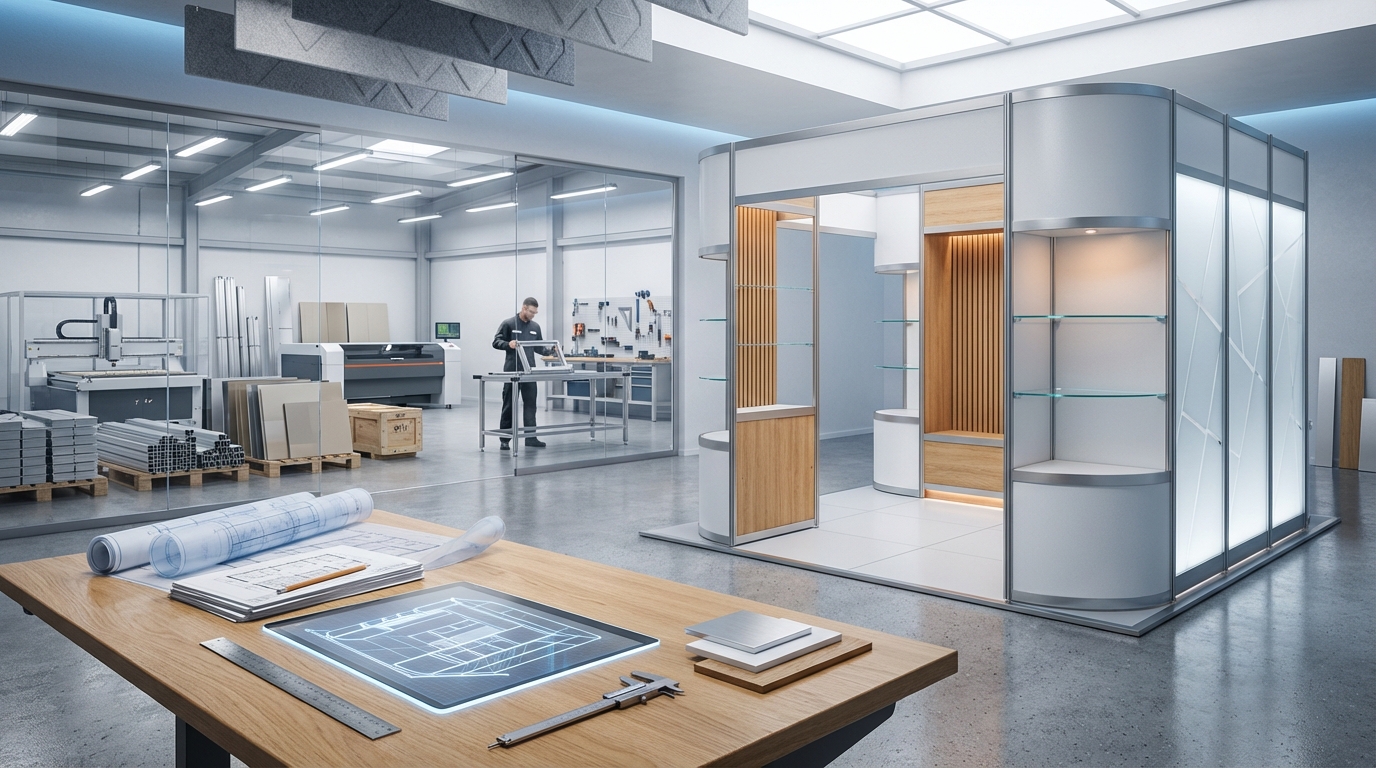
We reduce on-site risk through controlled pre-assembly in our Al Quoz warehouse. Our process includes:
- In-house fabrication with CNC precision for joinery and aluminium profiles to eliminate tolerance drift.
- Full-scale 3D mock-ups including structure, joinery, electrics and rigging points for client review and sign‑off.
- Testing modular connections, AV mounts and service runs so systems are plug-and-play on arrival at DWTC.
Benefits of the Burdak method
- Catch fit issues and clashes before transport—no surprises during the 3–4 day build window.
- Confirm rigging points, structural calculations and electrical routing with certified sign-off.
- Client sign-off on the mock-up reduces queries and accelerates on-site handover.
Logistics and DWTC coordination
We schedule timed transport, coordinate with DWTC for delivery slots, and manage Contractor Plus accreditation on behalf of clients. For complex builds we include certified rigging inspection and pre-booked DWTC checks to streamline access and reduce rework risk.
Practical checklist & timeline to guarantee green light at DWTC stand build regulations checks
Calendar and milestone timeline
- Design sign-off: January–February (allow time for revisions).
- Stand plan submission: by early March (approx. 60 days before event).
- Fabrication & full-scale mock-up: March–April in our Al Quoz facility.
- Services order & accreditation: April (power, rigging, Wi‑Fi, Contractor Plus badges).
- On-site build sequence: May 1–3 (fit, test, dress) ready for show opening May 4.
Budget items to include
- Structural certification and engineering fees for >4.0m or complex elements.
- Rigging inspection charges and DWTC inspection fees.
- Mock-up allowance (warehouse hire, labour, CNC cutting and finishes).
Final QA before handover
- RAMS (Risk Assessment & Method Statement) and site safety brief.
- Project manager on-site during build and opening.
- Contingency kit: spare fixings, adhesives, modular panels and a small joinery bench for quick fixes.
Call to action — Why choose Burdak for ATM 2026 and DWTC stand build regulations compliance
We offer single-point accountability: in-house joinery, electricians and project managers, eliminating the coordination gaps common with outsourced supply chains. Our double-decker capability and CNC accuracy mean we can deliver complex 4–6m structures with certified engineering and no outsourcing delays.
Offer: book a warehouse mock-up and guaranteed pre-assembly sign-off. We also provide fixed-price timeline packages—early booking recommended to secure fabrication slots and DWTC coordination.
FAQ
What are the DWTC height limits for ATM 2026?
Standard maximum height is 4.0m. Structures up to 6.0m may be permitted with engineered calculations, stamped drawings and additional inspections.
When is the stand plan submission deadline?
DWTC typically requires stand plans around 60 days before the event—for ATM 2026 that is early March. Late submissions are possible but may incur penalties or delayed inspections.
How many days access do contractors get on-site?
Space-only contractors generally have a 3–4 day on-site build window before show opening. This compressed period is the main reason we recommend pre-assembly and mock-ups.
Does Burdak handle Contractor Plus and accreditation?
Yes. We manage Contractor Plus registration, badge allocation and on-site contractor coordination as part of our service offering.
What does Burdak’s mock-up service include?
Full-scale assembly in our Al Quoz warehouse using CNC-fabricated components, rigging point tests, electrics and AV routing, and client sign-off prior to transport to DWTC.
For ATM 2026 planning and to book a mock-up slot, contact Burdak Technical Services now. Early engagement is the best way to secure fabrication capacity, engineer approvals and a smooth green-light at DWTC.