
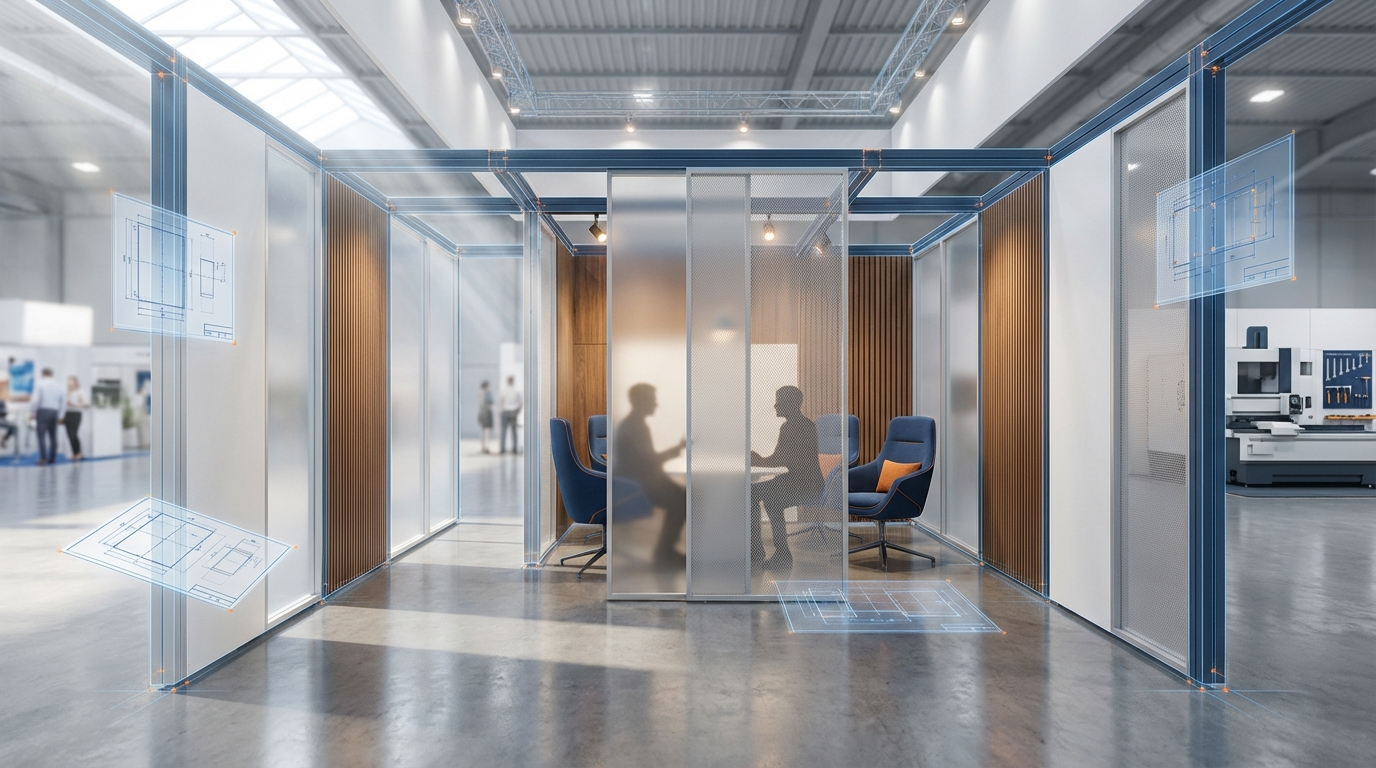
How to Safeguard Meeting Privacy Under DWTC's 50% Transparency Rule
DWTC 50% transparency rule is central to any confidential meeting plan at Arabian Travel Market (ATM) 4–7 May 2026. If your stand has a wall facing an aisle or neighbouring stand, DWTC requires at least 50% of that wall to be open or glazed. This article explains exactly what the rule requires, the real cost of non‑compliance, compliant design options that preserve confidentiality, and the Burdak Technical Services playbook to keep your build on schedule and inspection‑proof.
What DWTC’s 50% Transparency Rule Really Requires (Quick Technical Brief)
DWTC enforces a strict “no‑blanking” policy: any wall facing an aisle, island or neighbouring stand must be at least 50% transparent—either open, glazed or otherwise visually permeable. The rule applies to:
- Single‑front stands facing an aisle.
- Island stands where any elevation faces public circulation.
- Walls directly abutting neighbouring shell or space‑only stands.
Related DWTC conditions and documentation
- RAMS (site‑specific Risk Assessment and Method Statements) are required during submission and on site for all space‑only stands.
- Structures taller than 4.0 m require certified structural calculations and sign‑off.
- 3D/BIM submissions are required within DWTC timelines; late submissions or inadequate files commonly trigger penalties or inspection hold‑ups.
The Real Cost of Getting Privacy Wrong at ATM 2026
With ATM projected to host ~2,600–2,800 exhibitors and up to 55,000 trade visitors, DWTC inspections are active and unforgiving. Getting the DWTC 50% transparency rule wrong can be costly:
- On‑site modification time: converting a non‑compliant solid wall to compliant glazed/perforated systems can take from 4 hours to 48+ hours depending on access, materials and site MEP conflicts.
- Missed loading/installation slots: rework often causes missed Al Warsan marshalling/loading windows and delayed stand completion.
- Late MEP surcharges: late or ad‑hoc MEP/RAMS/BIM submissions commonly attract additional service fees of 20–50% from contractors or service providers.
- Inspection fines or blocked access: non‑compliant walls are frequently flagged for immediate modification; in extreme cases DWTC inspectors can restrict access until the issue is resolved.
Typical failure modes we see: outsourced builders skipping full‑scale pre‑assembly or mock‑ups, and solid wall removals mid build‑up once inspections begin. Both scenarios create critical path delays and cost overruns.
Compliant Design Solutions That Preserve Confidentiality
You can meet the DWTC 50% transparency rule while protecting confidential conversations. Practical, venue‑approved options include:
- Glazed panels (clear, smoked or acoustic laminated glass) — maintain visual privacy with tinted or fritted options; acoustic laminated glass reduces sound transmission for meeting rooms.
- Perforated metal slats or metal screens — provide partial visual permeability and design flexibility without sacrificing airflow.
- Louvers and angled slats — allow sightline control while meeting the 50% open requirement.
- One‑way vision film on glazed elevations — preserves outward visibility while reducing inward sightlines during exhibit hours.
- Internal meeting pods with an open frontage strategy — place pods set back from the façade to retain a 50% open elevation while containing discussions.
Material and fabrication notes
- Acoustic glazing: recommend laminated units with an acoustic interlayer (examples: 10–12mm laminated glass or double glazing using 6/12/6 configurations) achieving typical Rw values in the mid‑30s dB range depending on framing and seals.
- Frame tolerances: aluminium frames should allow ±2 mm tolerance at site to accommodate floor/level variations; design tolerances into pocketing and gaskets.
- Ventilation/pass‑through: if a meeting room is fully enclosed behind a glazed façade, integrate passive vents or route mechanical ventilation via MEP coordination in BIM — maintain compliance with venue ventilation requirements and avoid sealed rooms that impede egress or services.
- Fire‑rating compliance: use fire‑rated or fire‑retardant finishes and certified materials that meet DWTC/UAE Civil Defence expectations; apply intumescent seals where required for glazed junctions.
Burdak’s Technical Playbook — From Quotation to Sign‑off (In‑House Advantage)
We specialise in preventing the exact failure modes that stall builds at DWTC. Our in‑house approach includes:
- Rapid 24–48h quoting so design decisions don’t delay procurement.
- Assigned project manager and single‑point coordination for RAMS, BIM submissions and DWTC liaison.
- In‑house fabrication: carpentry, CNC precision, glazing and metalwork — we control tolerances, lead times and quality.
- Full‑scale warehouse pre‑assembly mock‑ups for client sign‑off to validate sightlines, acoustic performance and fit before transport.
- Logistics support: booked DWTC loading‑slot coordination, pallet/case numbering and Al Warsan marshalling schedules to protect your booked windows.
Step‑by‑Step Implementation Checklist & Timeline for ATM 2026 (Actionable)
- 0–21 days (Design freeze & prep)
- Confirm design and glazing choice (clear/smoked/acoustic).
- Prepare RAMS and BIM/3D files for DWTC submission; structural calculations if >4.0 m.
- 7–14 days (Mock‑up & testing)
- Full‑scale warehouse mock‑up and client approval.
- PAT testing and acoustic checks where required.
- 3–5 days before move‑in (Pre‑staging)
- Pre‑staging in our yard, pallet/case numbering and booked arrival times to Al Warsan marshalling.
- On‑site (Installation & contingency)
- Fast install plan, QA and Burdak on‑site team ready for immediate adjustments.
- Contingency parts and a technician on standby to avoid extended downtimes.
Closing CTA: Book a free 15‑point DWTC compliance readiness audit if you confirm your project with us within 21 days. We’ll review your design, RAMS/BIM plan and provide an action list to avoid late‑stage issues at ATM 2026.
FAQ
- What exactly counts as 50% transparency?
DWTC measures visible openness: a wall must be at least 50% glazed or open. Solutions include glazed panels, perforated screens, or open bay areas that cumulatively meet the 50% rule.
- Which elevations are subject to the rule?
Any elevation facing an aisle, neighbouring stand or public circulation is subject to the DWTC 50% transparency rule.
- What penalties apply for late MEP/RAMS/BIM submissions?
Late submissions frequently trigger additional service charges commonly in the 20–50% range and increase the risk of inspection holds or rework.
- Can I use one‑way vision film to meet transparency?
Yes. One‑way vision film on glazed elevations is an accepted solution to reduce sightlines while maintaining the glazed area required by DWTC. Ensure films and glazing meet fire and finish standards.
- How does Burdak prevent last‑minute issues?
We use rapid quoting, in‑house fabrication, full‑scale mock‑ups, and coordinated RAMS/BIM submissions so issues are resolved before the stand reaches DWTC. Our team also manages transport and booked loading slots to avoid costly delays.